

ICSI in Iran
At Ceritamed, ICSI Treatment in Iran combines advanced fertility technology, experienced specialists, and personalized patient care to help couples achieve successful pregnancy outcomes. With high success rates, affordable treatment costs, and comprehensive support for international patients, Ceritamed makes the journey toward parenthood safe, accessible, and stress-free.
- Top ICSI Success in Iran with Expert Care
- Affordable & Advanced ICSI Treatment
- Personalized ICSI Journey with Ceritamed
What Is ICSI (Intracytoplasmic Sperm Injection)?
Intracytoplasmic Sperm Injection (ICSI) is an advanced laboratory technique performed during an IVF cycle. Unlike conventional IVF, where fertilization occurs naturally in the laboratory, ICSI involves injecting a single healthy sperm directly into the egg to maximize the chance of fertilization.
Often referred to as Microinjection, ICSI has become the preferred treatment for couples affected by severe male infertility and is now widely used by fertility specialists worldwide.
What is ICSI and How Does it Work?
ICSI is a precision technique used during in vitro fertilization (IVF). Unlike standard IVF, where sperm and eggs are mixed in a dish, the ICSI procedure involves the direct injection of a single, healthy sperm into a mature egg.
In the region, this advanced method is often referred to as Microinjection in Iran. It bypasses many common barriers to fertilization, making it the most effective treatment for male infertility.
How Does ICSI Work?
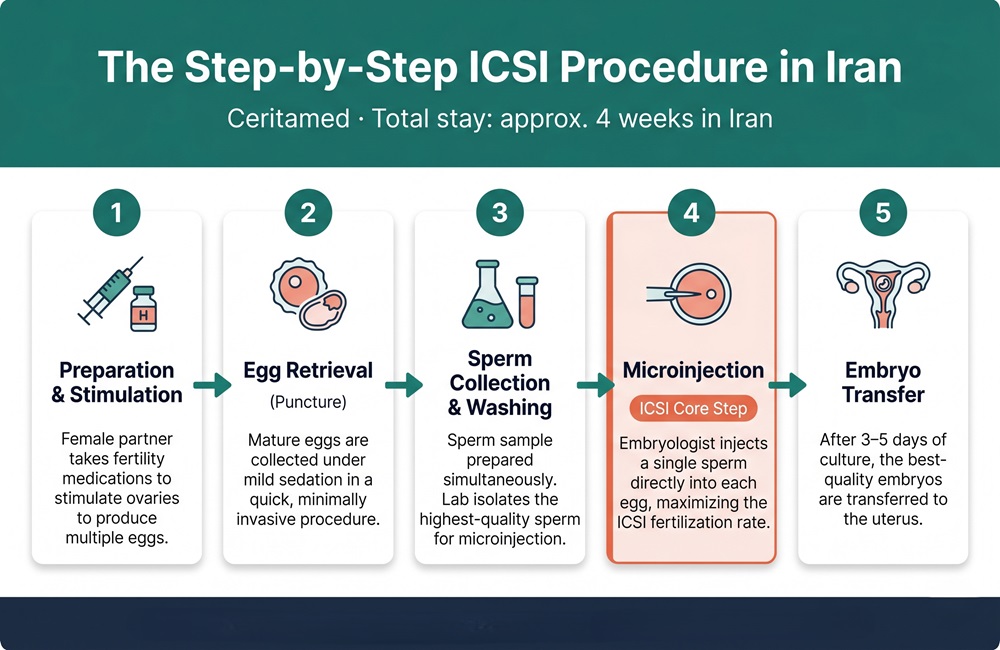
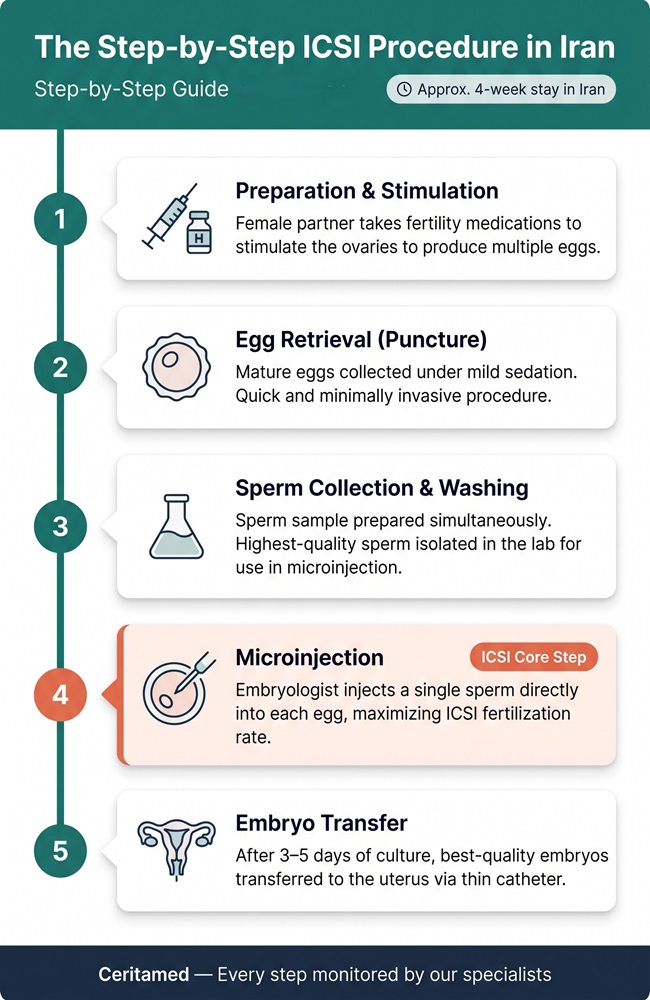
During the IVF process, mature eggs are collected from the ovaries while a sperm sample is prepared in the laboratory. An experienced embryologist carefully selects the healthiest sperm and injects it directly into each mature egg using specialized microscopic equipment.
After successful fertilization, the embryos are cultured for several days before the healthiest embryo is transferred into the uterus.
ICSI vs. Conventional IVF
Although IVF and ICSI follow similar treatment steps, the method of fertilization is different.
In conventional IVF, sperm must naturally penetrate the egg on their own. In ICSI, the embryologist performs the fertilization by injecting a single sperm into the egg. For couples with male factor infertility, IVF with ICSI often provides significantly higher fertilization rates than conventional IVF.
Who is the Best Candidate for ICSI?
ICSI in Iran is recommended for couples experiencing fertility problems that reduce the likelihood of natural fertilization. Following a comprehensive fertility evaluation, specialists determine whether ICSI treatment is the most appropriate option.
ICSI for Male Infertility
ICSI is most commonly recommended for men with male infertility, including reduced sperm count, poor sperm motility, or abnormal sperm morphology. By selecting and injecting a single healthy sperm into the egg, ICSI overcomes many of the barriers that prevent natural fertilization.
ICSI for Low Sperm Count
For men diagnosed with low sperm count, ICSI offers an effective solution even when only a limited number of healthy sperm are available. The procedure eliminates the need for sperm to travel through the female reproductive tract, improving the likelihood of successful fertilization.
ICSI for Azoospermia (TESE & PESA)
Men diagnosed with azoospermia (absence of sperm in the ejaculate) may still be able to achieve biological fatherhood through TESE (Testicular Sperm Extraction) or PESA (Percutaneous Epididymal Sperm Aspiration). These minimally invasive sperm retrieval procedures allow fertility specialists to obtain viable sperm that can be used immediately during the ICSI procedure.
ICSI Procedure & Success Rates
The ICSI procedure is performed as part of an IVF cycle and follows a carefully planned treatment process. Every stage is designed to maximize fertilization while providing personalized care based on each patient’s fertility condition.
Step-by-Step ICSI Procedure
A typical ICSI treatment cycle includes:
- Ovarian stimulation with fertility medications
- Ultrasound and hormone monitoring
- Egg retrieval under light sedation
- Sperm collection or surgical sperm retrieval (TESE/PESA), if necessary
- Laboratory fertilization using Intracytoplasmic Sperm Injection (ICSI)
- Embryo culture for 3 to 5 days
- Embryo transfer into the uterus
- Pregnancy testing approximately two weeks later
The entire treatment cycle generally takes three to four weeks, depending on the patient’s individualized treatment plan.
ICSI Success Rates
The ICSI success rate depends on several factors, including the woman’s age, egg quality, sperm quality, embryo development, and overall reproductive health. In leading fertility centers across Iran, the average pregnancy rate per treatment cycle ranges between 55% and 65%, with higher success rates often achieved in younger patients.
At Ceritamed, treatment is supervised by experienced fertility specialists, including Dr. Zahra Raofi, an OB-GYN and Fellowship-trained Infertility & IVF Specialist, who creates personalized treatment plans based on each couple’s fertility profile and medical history.
Woman’s Age | Average Pregnancy Rate per Cycle |
Under 35 | 55–65% |
35–39 | 40–50% |
40 and above | 20–35% |
Individual success rates vary, and a detailed fertility assessment is essential before starting treatment.
Advanced Fertility Options
Modern ICSI treatment in Iran can be combined with additional reproductive technologies to improve treatment outcomes for selected patients.
PGD / PGS Genetic Testing
Preimplantation Genetic Diagnosis (PGD) and Preimplantation Genetic Screening (PGS) allow embryos to be evaluated for chromosomal or inherited genetic conditions before embryo transfer. These techniques may improve the likelihood of a healthy pregnancy for couples with specific medical indications.
Gender Selection
For couples seeking family balancing, gender selection may be performed in combination with ICSI and PGD where permitted by applicable medical guidelines. Because embryo testing is used, this method provides significantly higher accuracy than sperm-sorting techniques alone.
Donor Egg & Donor Sperm
When pregnancy is not possible using a couple’s own gametes, donor egg or donor sperm programs may be considered in accordance with Iranian medical regulations and individual treatment requirements. Fertility specialists determine the most appropriate option after a comprehensive evaluation.
Recovery After ICSI
Recovery after ICSI treatment is generally quick. Most patients resume normal daily activities within one to two days following egg retrieval, while embryo transfer itself requires no surgery and involves minimal discomfort.
Throughout the treatment process, patients receive continuous medical guidance regarding medications, follow-up appointments, and pregnancy testing to ensure the best possible outcome.
Why Choose Ceritamed for ICSI Treatment in Iran?
Choosing the right fertility center is one of the most important decisions on your path to parenthood. At Ceritamed, international patients receive personalized fertility care through experienced specialists, advanced embryology laboratories, and internationally recognized fertility centers.
Our fertility network includes leading institutions such as the Royan Institute, Amin Infertility Treatment Center, Avicenna (Ibn Sina) Infertility Center, and Mom Fertility Center, providing access to modern assisted reproductive technologies and high-quality medical care.
Treatment is led by experienced fertility specialists, including Dr. Zahra Raofi, an OB-GYN and Fellowship-trained Infertility & IVF Specialist, who develops individualized treatment plans based on each patient’s fertility history and reproductive goals.
International patients also benefit from:
- Personalized treatment coordination
- Multilingual support
- Airport transfer and accommodation assistance
- Online follow-up after returning home
ICSI Cost in Iran
One of the biggest advantages of choosing ICSI in Iran is receiving high-quality fertility treatment at a considerably lower cost than many Western countries.
At Ceritamed, the ICSI cost in Iran generally ranges from $3,000 to $4,500, depending on the treatment protocol, fertility medications, laboratory services, embryo freezing, genetic testing (PGD/PGS), and any additional procedures such as TESE or PESA.
Transparent pricing and personalized treatment plans ensure patients understand all expected costs before beginning treatment, allowing them to plan their medical journey with confidence.
Fertility Specialist
Dr. Zahra Raofi
Gynecologist & Obstetrician | IVF & Infertility Fellowship Specialist

Dr. Zahra Raofi is an experienced infertility specialist with expertise in:
- IVF & ICSI
- Egg Donation
- Surrogacy
- PGD / PGS
- Gender Selection
Local SIM Card
Hotel
Visa Assistance
Medical Interpreter
Airport & City Transportation
Free Internet Access
Conclusion
ICSI in Iran represents a golden opportunity for couples struggling with infertility, especially severe male factors. By offering advanced techniques like Microinjection in Iran, TESE/PESA for azoospermia, and genetic screening (PGD), Iranian clinics provide comprehensive solutions. With ICSI Treatment in Iran, you gain access to high-success medical care at a significantly lower ICSI Cost compared to global competitors. Whether you require Male infertility treatment or are looking for gender selection options, Ceritamed is here to guide you through every step—from the initial online consultation to the joy of a positive pregnancy test. Trust in our expertise to turn your dream of parenthood into reality.
Procedure Overview
Treatment duration: approximately 3 weeks
Stay duration: approximately 3–4 weeks in Iran
Success rate: approximately 55–65% per cycle

ICSI Frequently Asked Questions
How long does the ICSI treatment process take?
A complete ICSI treatment cycle typically takes three to four weeks, from ovarian stimulation to embryo transfer. The exact timeline varies according to each patient's treatment plan.
Is ICSI more successful than conventional IVF?
For couples affected by male factor infertility, ICSI generally offers higher fertilization rates than conventional IVF because fertilization is performed directly by the embryologist.
Is ICSI safe?
Yes. Intracytoplasmic Sperm Injection (ICSI) has been safely used worldwide for more than three decades and is considered a well-established fertility treatment when performed by experienced specialists.
Can international patients travel to Iran for ICSI?
Yes. Intracytoplasmic Sperm Injection (ICSI) has been safely used worldwide for more than three decades and is considered a well-established fertility treatment when performed by experienced specialists.