


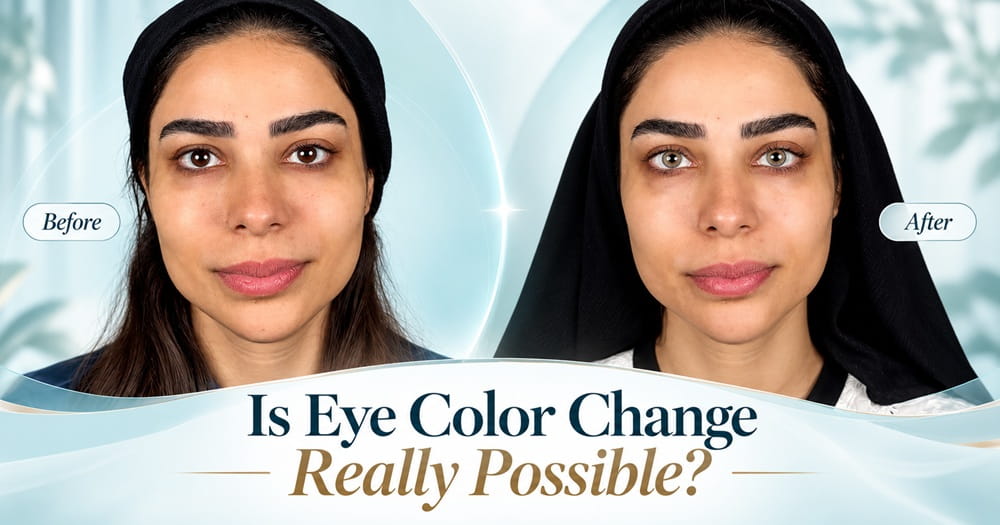

Is Eye Color Change Really Possible?
Eye color is one of the most distinctive facial features, and many people wonder whether it can actually be changed permanently.
The answer is yes. Advances in modern ophthalmology have made long-lasting eye color changes possible through specialized procedures. Depending on the technique, patients may choose a new eye color or gradually lighten their natural iris, with the most suitable option determined through a comprehensive eye examination.
In this article, you’ll learn how eye color change works, the available methods, whether the results are permanent, and who may be a suitable candidate.
What Determines Eye Color?
Natural eye color is mainly determined by melanin, the pigment found in the iris, and the way light interacts with its structure. Genetics plays a major role in these characteristics, creating a wide range of natural eye colors.
In general:
- Higher melanin levels → Usually brown eyes
- Moderate melanin levels and light scattering → Often hazel or green eyes
- Lower melanin levels → Usually blue eyes
Natural eye color typically remains stable after childhood, but that doesn’t mean its appearance cannot be changed.
How Can Eye Color Be Changed?
Modern ophthalmology offers different techniques for permanent eye color change.For cosmetic purposes, keratopigmentation (ETP) allows patients to select their preferred eye color, while laser iris depigmentation gradually lightens the natural iris.Artificial iris implantation is another technique described in medical literature, but it is generally not recommended solely for cosmetic purposes because of its potential risks.
Keratopigmentation (Corneal Pigmentation)
Keratopigmentation (ETP) changes the visible eye color by placing medical-grade pigments within a precisely created tunnel in the cornea. A femtosecond laser is used to create this tunnel, allowing the appearance of a new eye color without altering the natural iris.
- No implant placed inside the eye
- New eye color usually visible immediately after the procedure
- Selection from a range of available eye colors before treatment
- Used for cosmetic enhancement and selected reconstructive cases
Laser Eye Color Change
Laser eye color change uses controlled laser energy to gradually reduce melanin in the iris, allowing naturally darker eyes to develop a lighter appearance without adding artificial pigments.
- Gradual lightening of the natural iris color
- No artificial pigments or implants added
- Multiple treatment sessions may be needed
- Final eye color depends on individual iris characteristics
Unlike keratopigmentation (ETP), laser treatment does not allow patients to choose an exact final shade. A thorough eye examination and appropriate follow-up are important for assessing suitability and monitoring eye health.
Artificial Iris Implant
Artificial iris implants are devices placed inside the eye to change its appearance. This method was originally developed for reconstructive purposes in patients with severe iris defects.
However, it has been associated with a higher risk of complications, including:
- Glaucoma
- Chronic inflammation
- Corneal damage
- Vision complications
At Ceritamed, cosmetic artificial iris implant surgery is not offered due to its potential risks and safety considerations. Instead, our clinical practice focuses on keratopigmentation and laser eye color change after a comprehensive ophthalmic evaluation and careful patient selection.
Is Eye Color Change Only Cosmetic?
No. Although many people seek eye color change for aesthetic reasons, some ophthalmic procedures also have therapeutic and reconstructive applications.
For example, keratopigmentation may be used to improve the appearance of eyes affected by:
- Corneal opacity
- Corneal scars
- Severe corneal damage
This makes eye color change more than a cosmetic procedure in selected medical cases.
Are Eye Color Change Procedures Permanent?
Yes. Unlike temporary colored contact lenses, keratopigmentation (ETP) and laser iris depigmentation are designed to provide long-lasting eye color changes.
ETP uses medical-grade, biocompatible pigments placed within the cornea to create a lasting new appearance. Laser treatment reduces natural iris melanin, producing a lighter eye color over time.
The long-term appearance and color stability may vary depending on:
- The selected procedure
- Individual eye characteristics
- Healing response
- Appropriate medical follow-up
Am I a Good Candidate for Eye Color Change?
Not everyone is a suitable candidate for eye color change. Even with advanced ophthalmic techniques, eligibility depends on your eye health and a comprehensive medical evaluation.
Before any procedure, an ophthalmologist will assess:
- Corneal health and thickness
- Intraocular pressure (IOP)
- Overall eye condition
- Suitability for laser or keratopigmentation
It is also important to understand that not all desired eye colors or outcomes can be safely achieved in every patient. A personalized medical assessment is essential to determine the most appropriate and safe option.
If you’re considering a new eye color, explore our eye color change treatments in Iran to compare ETP and laser options, view real patient results, and learn how to arrange a personalized consultation.
Conclusion
Eye color change is now possible through modern ophthalmic procedures, offering long-lasting cosmetic results for suitable candidates.
Keratopigmentation (ETP) allows patients to choose from a range of eye colors, while laser iris depigmentation gradually lightens the natural iris.
At CeritaMed, a comprehensive eye examination helps determine which approach is most suitable for your eyes and desired appearance.
Scientific References
1. Dorgaleleh S, et al. Molecular and Biochemical Mechanisms of Human Iris Color: A Comprehensive Review. *Journal of Cellular Physiology*. 2020;235(12):8972–8982.
2. D’Oria F, Alio JL. Surgical Techniques for Cosmetic Eye Color Change: A Narrative Review. *Ophthalmology and Therapy*. 2025;14:1685–1694.
3. Alio JL, et al. Femtosecond Laser-Assisted Keratopigmentation Outcomes for Pure Cosmetic Purposes. *American Journal of Ophthalmology Case Reports*. 2025;38:102297.